
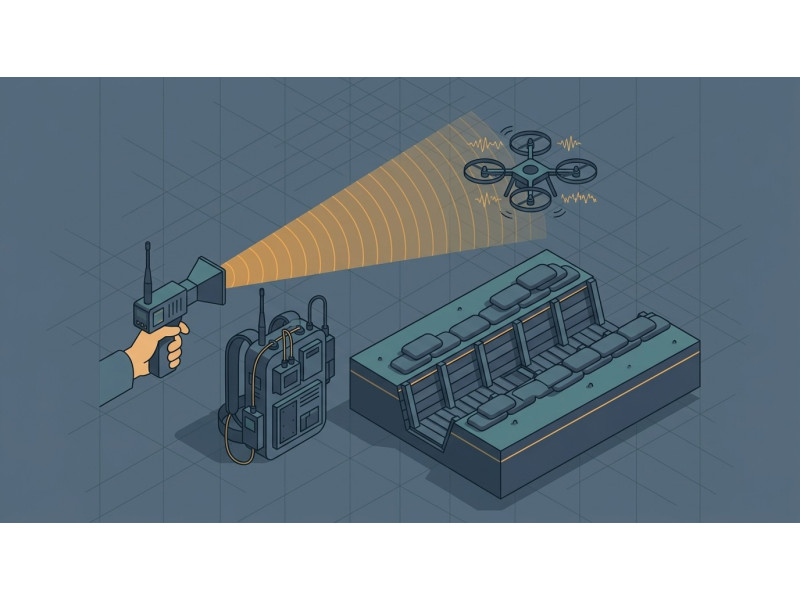
Portable EW is a compact wearable anti-drone tool for those who work without a vehicle: a trench, an observation post, an assault. In plain terms: you switch it on the moment a threat appears, and it jams drone control at close range.
What portable EW is
It's a portable version of EW gear: a handheld "gun" or a wearable backpack station. Unlike a vehicle complex, portable EW protects not the gear but the soldier and the space right around them.
Its main advantage is that you can always take it with you. It's personal protection from FPV and drops, not a stationary solution.
Who needs it
Portable EW is for infantry, assault teams, crews and observers — anyone without a vehicle-mounted complex on hand.
Where vehicles can't pass or aren't present, a handheld device remains the only prompt tool against a drone at close range.
The «Patelnia» anti-drone gun
The most common format is the directional handheld «Patelnia». You aim it toward the drone and cut its control and video channels.
· KANT-M-4 «Patelnia» — on 2.4 / 5.2 / 5.8 GHz, drop protection from DJI Mavic 3 and 4.
· KANT-M-3 «Patelnia» — a more compact version on 2.4 and 5.8 GHz.
The directional form concentrates power toward the drone instead of scattering it — so at close range it's effective.
How to use it
The main rule is to keep the device ready and switch it on at the first signs of a drone: sound, visual contact, a spotter's warning.
Don't radiate continuously: it drains the battery and gives away the position. Handheld EW is a "button for when a threat appears"; for constant perimeter cover a vehicle dome complex makes more sense.
Power and weight
Portable EW runs on a built-in battery charged from a socket or a power bank. For long watches it's worth having a spare source.
The format is made for carrying: the station goes in a backpack, the gun stays at hand. Check exact weight and runtime on the specific model's page — they differ between KANT-M-3 and KANT-M-4.
Frequencies and limits
«Patelnia» works on 2.4 / 5.2 / 5.8 GHz — the bands of Mavic and much of FPV. Low-band FPV needs wider solutions; then the handheld tool is combined with a multi-band complex.
We're honest about this: a compact device doesn't replace a full dome — it complements it where the soldier operates alone.
Wearable station or handheld "gun": which to choose
The handheld and wearable formats solve a similar task differently, so the choice depends on how you operate.
The handheld "gun" suits a single soldier: kept ready and aimed at a drone the moment a threat appears. It's lighter and simpler, but it works only while the soldier holds it and sees the target.
The wearable station in a backpack gives more autonomy and can cover the surrounding space more broadly without constant aiming. It's heavier but frees the hands.
In practice a crew often takes both: the gun for a pinpoint break on a specific drone, the station for background cover of a small group. Which fits you we'll advise via contacts from your task description.
Questions & answers
What is a trench jammer?
A compact wearable EW device for positions. It creates radio interference and jams a drone at close range when no vehicle complex is nearby.
How long does handheld EW run on battery?
It depends on the model and mode. We advise keeping a spare power source for long watches; exact figures are on the product page.
Does the anti-drone gun protect against drops?
Yes. «Patelnia» covers Mavic 2.4/5.8 GHz channels, so it breaks drone control during a drop run.
Is portable EW heavy?
The format is made for carrying: the station goes in a backpack, the gun stays ready. Check the exact weight on the model's page.