
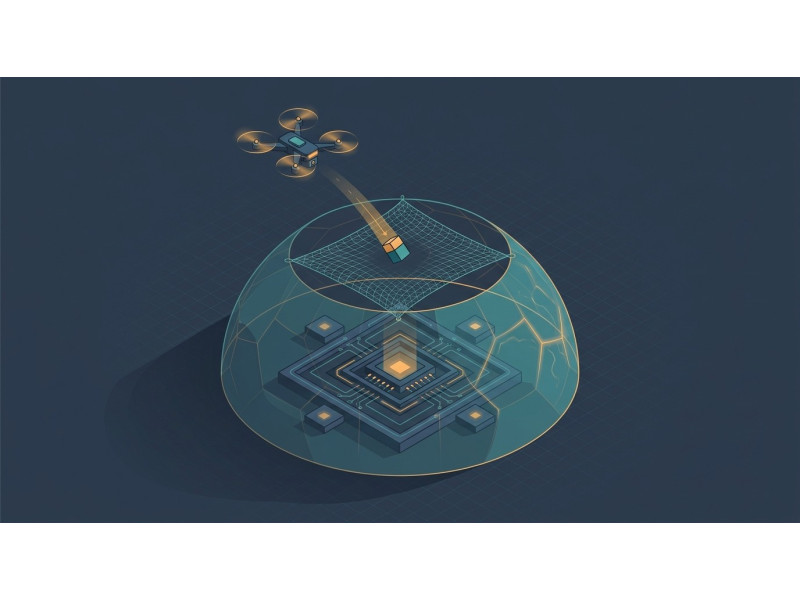
In short: the most reliable protection from
drops is to stop the drone from aiming. For that you jam its control channels
with handheld EW, and cover the space above the position with a net. Let's go
through the methods.
What a "drop" is and why it's dangerous
A drop is when a drone (most often a DJI
Mavic) moves over a position and releases a munition. The aircraft is
controlled by radio on 2.4/5.8 GHz and aims by live video.
The weak point here is exactly the radio
channel. Block it, and the operator loses control and accuracy, and the drop
fails.
Method 1. Handheld EW
The most effective tool against drops on a
position is directional handheld EW. You aim it at the drone and jam the
2.4/5.8 GHz channels, breaking the aim.
·
KANT-M-4 «Patelnia» — 2.4/5.2/5.8 GHz, built specifically for drop protection from
Mavic 3 and 4.
·
KANT-M-3 «Patelnia» — a more compact version on 2.4 and 5.8 GHz.
This is the soldier's core tool against
drops; more on the format in the article on portable EW.
Method 2. Nets and physical barriers
A net over a trench or dugout keeps a
released munition from hitting precisely and slows FPV. It's passive protection
that works well paired with EW.
The downside of nets is that they're
stationary and don't help on the move. So they go on fixed positions, while EW
provides mobility.
Method 3. A vehicle dome on the move
For gear on the route, drops are broken by vehicle dome EW.
It holds a field of interference around the car, so the drone can't lock onto a
moving target.
Here it matters that the complex covers
2.4/5.8 GHz — the exact frequencies a Mavic uses for drops. How to choose bands
is described in the article on EW frequencies.
Method 4. Camouflage and discipline
The cheapest protection is not being
spotted. Camouflage nets, thermal control and minimal daytime movement reduce
the chance a drone even lines up a drop.
It's not a replacement for EW but a first
layer: the less you're seen, the less often you have to jam.
How to combine methods
Reliable defense is layered. Camouflage
lowers the chance of detection, a net complicates a precise drop, and handheld EW
breaks the drone's control at the decisive moment.
Not sure where to start — message contacts, and we'll
match a tool to your position type and threat.
Common mistakes in drop protection
A few frequent errors undo even good
equipment.
Switching
EW on too late. If you wait until the drone is
overhead, there's almost no time to react. Early warning helps — a drone detector
or an attentive spotter.
Relying
on a single tool. A net alone won't stop a guided
run; EW alone doesn't help when switched off. It's the combination of methods
that works.
Ignoring
camouflage. The cheapest protection is not being
spotted. If a position is visible from afar, the drone will line up a drop
before you react.
Forgetting
frequencies. EW against drops must cover 2.4/5.8
GHz. A complex without these bands is ineffective against Mavic drops — details
in the article on EW
frequencies.
Questions & answers
How do I protect against drops from a Mavic?
Jam the drone's 2.4/5.8 GHz control
channels with handheld EW and cover the position with a net. On the move — a
vehicle dome.
Does an anti-FPV net really help?
Yes, as passive protection: it slows the
aircraft and spoils drop accuracy. It works best paired with EW.
Which EW should I choose against drops?
A directional handheld unit covering
2.4/5.8 GHz — for example «Patelnia» KANT-M-4 or KANT-M-3.
Is EW alone enough without a net?
EW breaks control, but layered defense is
more reliable. A net and camouflage back it up where EW is late or switched
off.