
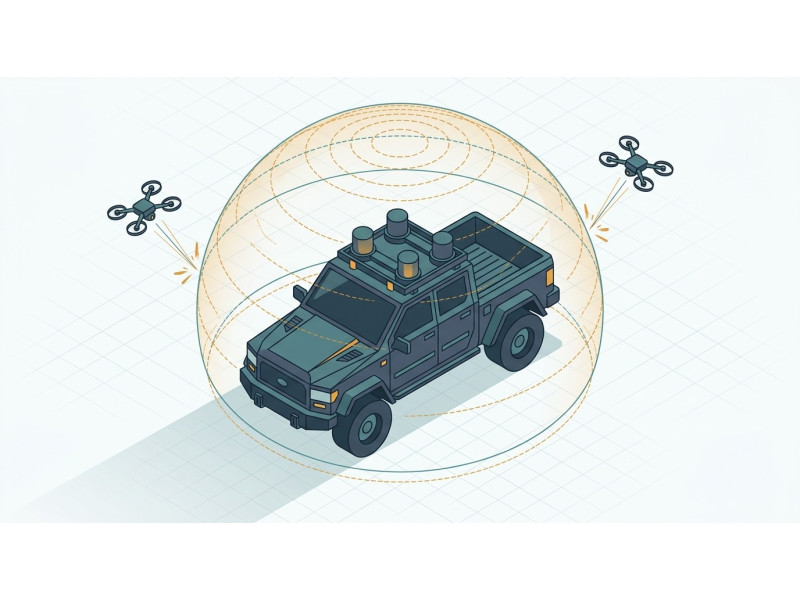
Vehicle EW is a dome complex that rides
with the car and covers it in a field of radio interference. In plain terms: it
jams drone control along the route, so FPV strikes and Mavic drops never reach
the target. Let's see how it's built.
What the EW "dome" is
The "dome" is a notional sphere
of interference around the carrier. Several antennas radiate in different
directions, and together they form a continuous zone where a drone loses
control.
The dome radius of complexes like «Amulet-6M»
is up to 180 meters. The real distance depends on the model, band, power and
terrain.
What vehicle EW looks like
On the outside it's a set of cylindrical
antennas on the roof or frame plus a control-and-power block in the cabin or
bed. The antennas are arranged to cover the space around the car evenly.
The complex is built for vibration and
shock, so it works off-road and on the move. It's not a "case for
parking" but a system that protects the car exactly when it's driving.
Models: «Amulet» and «Omega»
The core of the vehicle line is the «Amulet»
series. Models differ by band set: from narrow FPV-only to multi-band
"cover-all".
When maximum coverage is needed, buyers
take «Omega-1» — a rail-mounted dome complex on
300–580, 700–1050 and 1700–2700 MHz. It closes FPV, Mavic and low-band aircraft
at once.
Which band to choose depends on the threat;
the selection logic is detailed in the article on EW frequencies.
Power and autonomy
On the move the complex runs off the 12/24
V on-board network. When parked — off a standalone battery charged from the car
or a wall socket.
Runtime depends on the model (up to 55
minutes of active operation on the Amulet-6M). For long watches buyers add a
spare battery or keep the engine on charge.
Installation
A dome jammer mounts on the roof or frame.
Antennas are spaced for even coverage; the control block goes in a protected
spot.
Installation is doable yourself, but there
are nuances: clean connectors, correct cables, no extra adapters. Why this
matters is covered in our piece on N-type
connector overheating.
What to consider before buying
The main thing is to match the complex to
the carrier. A light pickup and heavy armor pull different systems by power and
mounting.
Second — which drones you're covering. That
sets the band mix. Third — whether you need extra antennas
and cables.
For infantry on the same vehicle it helps
to also have a portable
EW so the soldier is covered off the car too.
Maintenance in the field
A dome jammer withstands field conditions,
but a few simple habits extend its life and keep it effective.
Watch the connectors and antenna mounts: a
loose or oxidized contact drains power, and the dome radius drops. Periodically
check tightness and cleanliness of the joints.
Plan power ahead. For long watches keep a
spare battery or the engine on charge — otherwise the complex shuts down at the
worst moment.
And above all — check that it works before
heading out, not after. A complex whose serviceability no one confirmed easily
gives a false sense of protection. We covered the testing method separately in
the article on testing EW.
Questions & answers
What is the radius of vehicle EW?
Up to 180 meters around the carrier for
dome complexes. The exact distance depends on model, band, power and terrain.
What does vehicle EW look like?
Antennas on the roof or frame plus a
control-and-power block. The antennas are spaced to cover the space around the
car.
Can I install vehicle EW myself?
Yes, it mounts on the roof or frame and
connects to the on-board network. We provide instructions and advise on
installation.
Does vehicle EW protect against Mavic drops?
Yes, if it covers 2.4/5.8 GHz. For stronger
drop protection, add a handheld EW.