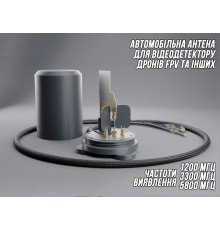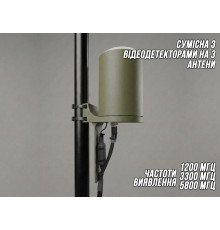
This section has everything that boosts a drone's signal and keeps an EW complex running: signal-boost antennas for DJI Mavic 3 and 4, EW antennas, coax cables and connectors.
In short: the right antenna adds control range, while a quality cable and connector stop the system from losing power.
Drone antennas with a control signal booster
A range-extender antenna widens the zone of a reliable link between the controller and the drone. That matters where there is heavy interference or a long distance to the aircraft.
The «Wizard» antenna boosts the signal on 2.4 / 5.2 / 5.8 GHz and works with the native Mavic controller. As a result, the drone holds control and video more steadily at range.
Reconnaissance operators and spotters choose such an antenna when they need to reach an aircraft in a crowded RF environment.
EW antennas and circular polarization
An antenna is half of an EW complex's effectiveness. Its type decides how evenly the interference covers the space around the carrier.
For omnidirectional coverage, circularly polarized antennas are used — they radiate evenly, with no narrow gaps. We covered antenna types in EW systems in the article on «Clover» and «Quadrifilar».
5D-FB and LMR-400 cables
The cable connects the interference generator to the antenna, and this is exactly where power is often lost. We offer low-loss coax cables.
The 5D-FB cable gives a good balance of low loss and flexibility — handy for fast deployment on a position. LMR-400 handles more power over longer runs.
Both suit combat conditions where the system must be assembled quickly and reliably.
N-type connectors and overheating
The connector is the weakest link in the path. A cheap connector heats up under load, and even with perfect SWR the system loses effectiveness.
We select heat-resistant N-type connectors rated for long operation. Why joints overheat and what it leads to is explained in the article on N-type connectors.
What pairs with what
A simple build:
- «Wizard» antenna — for Mavic control range.
- 5D-FB / LMR-400 cable — to connect antenna and complex without losses.
- N-type connectors — for a reliable joint under load.
Building a system from scratch? Go back to the EW equipment hub — that's where the complexes these accessories fit are listed.
Why a signal booster matters at range
A drone holds its link as long as the controller's signal "outweighs" the surrounding noise and interference. At distance or in a crowded RF environment the stock antenna often falls short — the picture breaks up and control lags.
A range-extender antenna with a booster raises the level of the useful signal, so the operator keeps control where the standard kit already gives up. It shows most over difficult terrain and in cities, where there are many reflections.
One thing to understand: a booster doesn't make a drone "immune" to enemy EW — it only widens your working zone. It's a range tool, not a protection tool.
Connectors, adapters and cable length
Beyond the cable and antenna, the path has small things that are easy to underestimate: adapters, run length, solder quality. Every extra joint means losses and a potential overheating point.
So we advise against stacking "adapter on adapter" and instead choosing a cable of the right length with the correct N-type connectors for your specific antenna. A shorter, cleaner path almost always beats a long one "built from whatever was around".
Not sure about connector compatibility? Send a photo of your antenna and controller to contacts and we'll match a kit.
Which drones the antennas fit
Range-extender antennas are built first of all for the popular DJI Mavic 3 and 4, since those fly most often in the front-line zone. The principle is simple: the antenna boosts the band the drone uses for control and video.
For other platforms the logic is the same, but you have to check the controller's frequencies. So before ordering it's worth confirming your drone model — that way we match an antenna that actually adds range, not just "fits the connector".
EW antennas are a separate story: what matters there is the radiation pattern and polarization for a specific complex, not controller compatibility. We'll sort those nuances out at the selection stage too, so the antenna works in pair with your Amulet or Omega from the EW equipment hub.
Questions & answers
Which antenna fits Mavic 3 and 4?
A range-extender antenna with a booster on 2.4/5.2/5.8 GHz, for example the «Wizard». It works with the native controller and increases range and stability.
Why does a booster antenna need a 5D-FB cable?
To keep what the antenna adds. A low-loss cable preserves signal power between the controller/complex and the antenna.
Which cable — 5D-FB or LMR-400?
5D-FB is more flexible and handy for mobile deployment; LMR-400 handles power better over long runs. We'll advise for your task via contacts.
Why do N-type connectors matter?
They are rated for high frequency and power. A quality N-type heats up less and doesn't drain the signal under long load.