
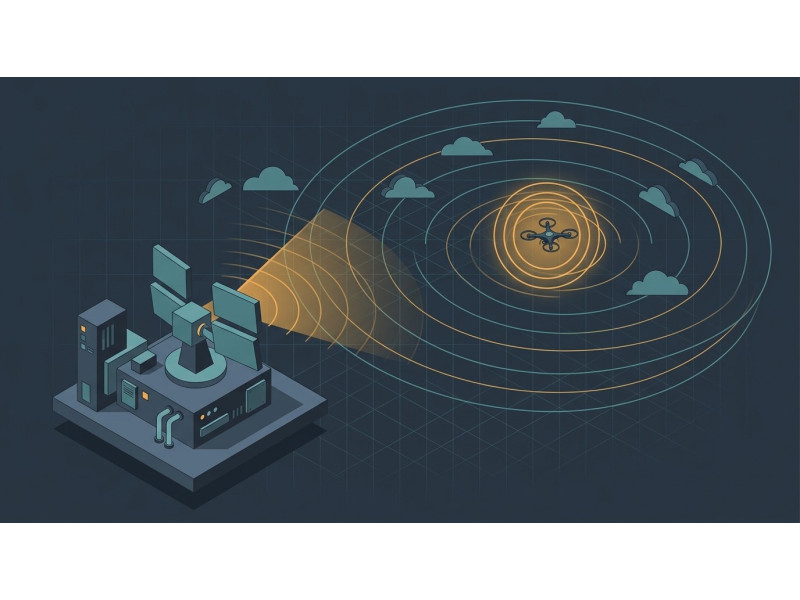
In short: a drone detector doesn't jam the aircraft — it detects it. Detection and suppression (EW) are two different tasks, and reliable defense is built on both. Let's see how detectors work and how they pair with EW.
What a drone detector does
A detector "listens" to the radio spectrum and catches the signals a drone exchanges with its operator. When a characteristic signal appears, the device warns: a drone is near.
That gives the most valuable thing — time. A few seconds of warning is enough to take cover or switch on EW in time.
How it works
Most detectors are radio receivers tuned to the bands drones use. They analyze the spectrum and react to familiar "signatures" of control and video signals.
The more bands a detector covers, the wider the range of aircraft it sees. Hence the popular request for a "4-band drone detector": four bands give wider coverage.
Detection vs suppression
This is the key distinction. A detector answers "is there a drone?". EW answers "how do I stop it?".
One without the other works worse: EW without a detector is switched on blind, and a detector without EW only warns but doesn't protect. So they're used together — a principle we also cover in what is EW.
Which detector is "best"
There's no universal answer — it depends on the task. Judge by a few parameters:
· Bands — wider coverage means more aircraft seen.
· Sensitivity and range — at what distance it notices a drone.
· Format — wearable for a soldier or stationary for an object.
· Autonomy — battery runtime.
Don't chase "the best overall" — take the one that sees the drones on your frequencies. The article on EW bands helps identify those.
Detector and EW in one system
In practice the pairing looks like this: the detector warns of a drone, the soldier or operator assesses the threat and switches on the right EW tool — handheld on a position or vehicle on the move.
This approach saves both the EW resource (it isn't running constantly) and reduces signature — you radiate only when there's a real target.
Do we advise on detectors
We specialize in EW gear and antennas, but we help build the whole defense logic — from detection to suppression. If you need to match a detector to your EW complex by frequency, get in touch via contacts.
Passive and active detection methods
Drone detection comes in different forms, and it helps to know how the approaches differ.
Passive methods radiate nothing — they only "listen". A radio detector catches control and video signals; an acoustic one catches the characteristic motor sound. The advantage of passive tools is that they don't give away a position.
Active methods illuminate the space themselves and analyze reflections (the radar principle). They see even "quiet" aircraft but are more complex and costly, and can give away a position.
In the retail anti-drone segment passive radio detectors dominate — they're simple, autonomous and pair well with EW. The main thing is that the detector covers the same frequencies your complex will later jam.
Questions & answers
Does a drone detector jam the aircraft?
No. A detector only finds a drone and warns about it. Jamming is EW. These are different tasks.
What does a "4-band detector" mean?
That the device covers four frequency bands and therefore sees a wider range of drones — both FPV and Mavic.
Which drone detector is best?
The one that covers the drone frequencies of your area, has enough range and a convenient format. There is no "best for everyone".
Why a detector if I already have EW?
So you don't switch EW on blind. A detector gives time and a signal for exactly when to start suppression — saving resource and reducing signature.