
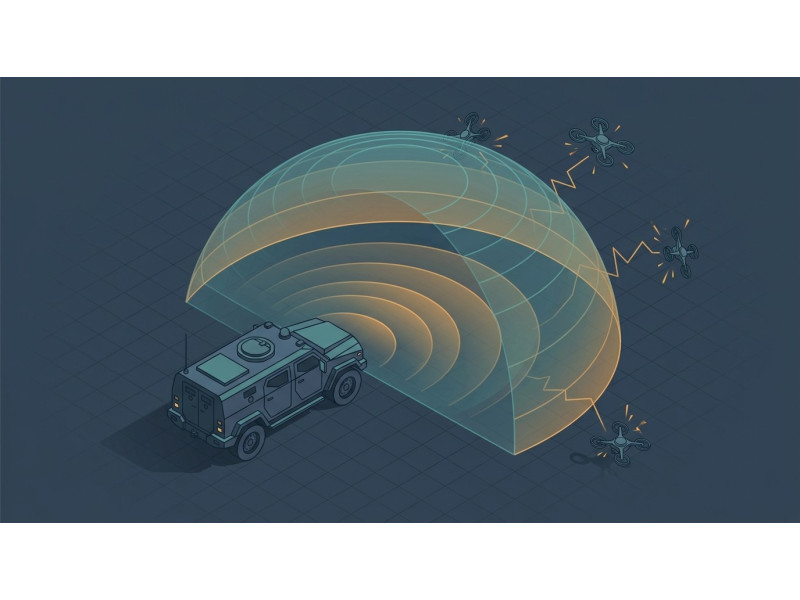
In short: EW stands for electronic warfare. The device creates radio interference and breaks the link between a drone and its operator, so the aircraft loses control, hovers or falls. Below is the detail, without heavy jargon.
What EW stands for
EW means electronic warfare — a general term for tools that affect an adversary's radio signals: drone control, communications, navigation.
In everyday use "EW" most often means anti-drone tools — complexes that shield vehicles and positions from FPV and Mavic drones. Those are the focus here.
How EW works
Every drone is controlled by radio: the operator sends commands, and the aircraft streams video back. Both channels run on specific frequencies.
EW radiates strong "noise" on those same frequencies. The useful signal drowns in the interference, and the drone no longer "hears" its operator. What happens next depends on the aircraft: it hovers, returns to its launch point, or simply drops.
The key rule: to jam a drone, EW must cover the frequency that drone uses. So choosing the bands is the central question — covered in the article on EW frequencies.
Types of EW gear
By format, EW tools split into a few types.
Vehicle — dome complexes on the roof or frame of a car. They travel with the gear and hold a protective "dome" around it. See how vehicle EW works.
Portable (trench) — compact stations and handheld "guns" for infantry. Taken where there's no vehicle: a trench, an observation post, an assault. More in portable EW: what it is.
Stationary — for fixed objects; rarer in the retail segment.
Formats are often combined: a vehicle complex covers transport, while a handheld unit stays with the soldier.
What EW protects against
The main threat today is small drones: FPV kamikaze and commercial Mavic aircraft used for drops. That is what most EW gear targets. See our piece on FPV and kamikaze drones.
EW does not physically "shoot down" the drone — it strips its control. So effectiveness depends on how tightly the needed frequencies and directions are covered.
What EW does not do
It matters to know the limits. EW does not see a drone — it only jams. To react in time, the aircraft must first be detected: visually, by sound, or with a drone detector.
EW also has no effect on aircraft flying outside its band, or on drones with autonomous guidance and no radio link. There is no single "one device for everything" — the solution is matched to the threat.
Where to start
Begin with a simple question: what are you protecting. Gear on the move — see vehicle EW. A position or a soldier — portable handheld EW. A general overview of all tools — in the EW equipment catalog.
If you don't know which drones fly in your area, message contacts — we'll suggest a configuration from other buyers' experience.
Common myths about EW
Several oversimplifications get in the way of a good choice. Let's clear a few.
"One powerful EW jams everything." No. If the complex doesn't cover a given drone's frequency, power won't help — the aircraft simply won't notice the interference. Bands decide, not watts alone.
"EW makes a position invisible." No. EW jams control, but it radiates itself and can give away a position. So it's switched on when needed, not kept running constantly.
"With EW you don't need a detector." These are different tasks: a detector finds, EW suppresses. Without detection you switch EW on blind and waste resource.
Understanding these limits saves budget: it's often smarter to take a simpler complex matched to the real threat than "the most powerful" universal one.
Questions & answers
What is EW in simple terms?
A device that creates radio interference and jams the link between a drone and its operator. The drone loses control or video and can't complete its task.
How does EW work against drones?
It floods the frequencies a drone uses for commands and video with noise. Once the channel is blocked, the aircraft hovers, returns, or falls.
Does EW physically shoot down a drone?
No. EW doesn't destroy the aircraft; it removes control. The drone then behaves according to its settings.
Which EW for a vehicle, which for infantry?
For gear on the move — a vehicle dome complex. For positions and soldiers — a portable handheld unit. Buyers often take both.