
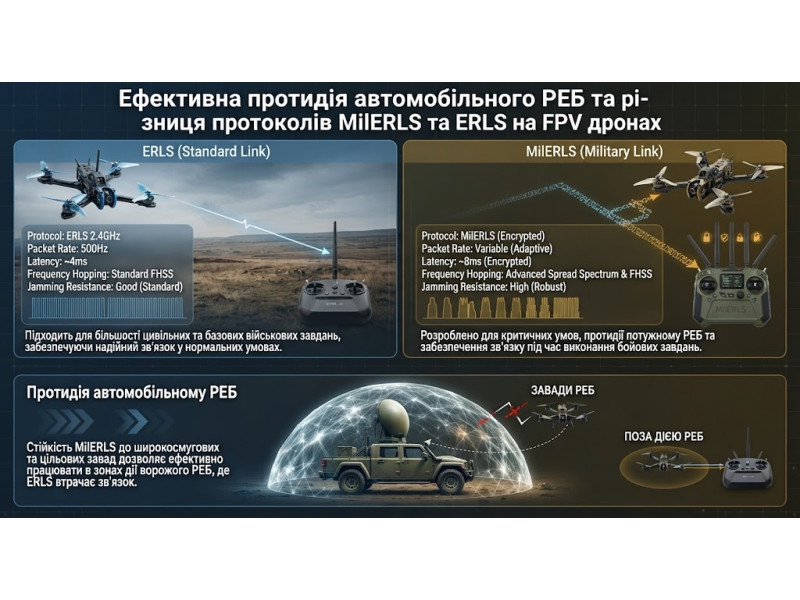
In modern warfare, electronic warfare (EW) has become a key element in ensuring the protection of armored vehicles, logistical columns, and assault
groups. Of particular urgency is the issue of defense against FPV drones, which are controlled over long distances using secure digital radio protocols.
For owners and engineers involved in the development,
testing, or marketing of vehicular EW systems, it is critically important to
understand the physics and mathematics of the jamming processes. In this
article, we will examine in detail why standard communication protocols lag
behind military modifications, and provide precise calculations of the
effectiveness of dome EW systems depending on packet rate, time-on-air (ToA),
and frequency-hopping spread spectrum (FHSS) algorithms.
1.
Architectural Differences Between Protocols: ERLS vs. MilERLS
To understand how a vehicular EW system affects a
drone's control channel, it is necessary to analyze the underlying transmission
architecture of both protocols.
Standard
ERLS Protocol (Express Long Range System)
This protocol was designed as a high-speed and sensitive
solution for civilian and basic military applications.
·
Packet Rate: Most commonly configured between 250 Hz
and 500 Hz. This means the remote control and drone receiver exchange data
packets every 2 - 4 milliseconds.
·
Time-on-Air (ToA): Due to the high bitrate speed, the
duration of each individual packet is minimal (around 1 - 1.5 ms).
·
Operating Logic: High packet frequency ensures
extremely smooth control and minimal latency (latency under 5 ms). However,
this creates an intensive, continuous stream of micro-packets in the radio
spectrum.
Military
MilERLS Protocol
Created specifically for harsh electronic
countermeasure conditions. It shifts the focus from ultra-low latency to
maximum energy resilience and anti-intercept protection.
·
Packet Rate: Reduced to critically minimal or adaptive
values (e.g., 44 Hz or dynamic adjustment depending on channel conditions). The
interval between packets (Tint) increases to approximately 22.7
ms (at 44 Hz).
·
Energy per Bit and Processing Gain: By lowering the
packet rate, the protocol concentrates more energy into each transmission and
uses advanced spread spectrum techniques with a wider data packet.
·
Operating Logic: The drone does not "clog"
the spectrum with frequent packets, but transmits them less frequently while
maintaining a higher level of cryptographic protection and structural
resilience against interference.
2.
Mathematical Model of Vehicular EW Impact
The effectiveness of electronic jamming (Jamming
Effectiveness, $E_j$) depends directly on the
Jamming-to-Signal Ratio ($J/S$), as well as the temporal characteristics
of the interference interacting with the data packet (Dwell Time).
Signal-to-Noise
Ratio Formula with Interference
In the coverage zone of a vehicular dome EW system, the
resulting signal-to-noise ratio at the input of the FPV drone receiver is
described by the equation:

Where:
·
Ptx —
transmitter power of the remote controller;
·
Pj —
output power of the vehicular EW system;
·
W — channel
bandwidth;
·
Gj —
antenna gain of the EW system directed toward the drone;
·
 - path loss gradient
depending on the distance to the jammer and the drone.
- path loss gradient
depending on the distance to the jammer and the drone.
Packet
Loss Probability (Ploss)
To estimate whether the drone can maintain control, the
probability of successfully jamming an individual data packet is used. It
depends on the jammer's dwell time (Tdwell)
relative to the packet interval Tint:
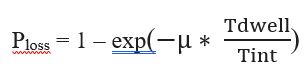
where $\mu$
is the energy excess coefficient of the jammer over the useful signal within
the bandwidth.
3.
Detailed Comparative Calculation for ERLS and MilERLS
Let us examine how the mathematical model above works
in practice when an FPV drone enters the coverage zone of a vehicular EW system
with an output power of several hundred watts and a dome radiation pattern.
Scenario
A: Drone Using ERLS Protocol (500 Hz)
1.
Time
Parameters: The interval between packets is only 2 ms.
2.
EW
System Response: Due to broadband or fast dome sweep jamming, the vehicular
EW covers the entire frequency range with an update period of less than 1 ms.
3.
Link
Failure Calculation: Since packets flow continuously and their duration is
minimal, the link protection algorithm fails to accumulate a complete frame.
Losing 3–5 consecutive packets (>10 ms) is treated by
the receiver as a critical failure.
4.
EW
Efficiency Coefficient: Due to the high packet rate, ERLS becomes an easy
target for vehicular systems. The probability of successful suppression is 92–98%. The drone quickly
loses control and enters a failsafe emergency landing or crash mode.
Scenario
B: Drone Using MilERLS Protocol (44 Hz)
1.
Time
Parameters: The interval between packets is significantly
larger—approximately 22.7 ms. The packet structure itself is temporally
stretched to provide higher energy per bit.
2.
Dwell
Time Requirement: To completely block such a packet, the vehicular EW must
hold or cover a specific narrow frequency for an extended duration (≥
20 ms), or create excessively powerful interference across the entire
channel width.
3.
Packet
Transmission Calculation: If the jamming generator operates in a fast sweep
mode, its "beam" passes through the operating frequency in
milliseconds. The infrequent MilERLS packet manages to "slip through"
the time gap between jamming scan cycles.
4.
EW
Efficiency Coefficient: Due to the adaptability and low packet rate, the
effectiveness of a standard vehicular EW drops to 45–60%. To guarantee suppression of this protocol,
the vehicular system must feature either ultra-high power density in the
kilowatt range or intelligent digital interception modules with adaptive
frequency tracking.
4.
Conclusions for Developers and Buyers of Vehicular EW Systems
Summarizing the mathematical calculations and field
data, several strategic conclusions can be drawn for the vehicular
counter-measures market:
·
Standard Countermeasures are Ineffective Against Upgrades:
Classic vehicular EW systems designed solely to jam older analog channels or
high-frequency civilian protocols (like standard ERLS at 500 Hz) show excellent
results (up to 95% effectiveness).
·
The Need for Equipment Evolution: The proliferation of
the MilERLS protocol requires manufacturers of vehicular systems to transition
to new jamming generation algorithms — increasing dwell time, implementing
feedback systems, and expanding the energy potential of dome antennas.
·
Commercial Value: Having reliable protection against
modern adaptive protocols is a key competitive advantage for commercial EW
systems supplied for frontline vehicle equipment.