
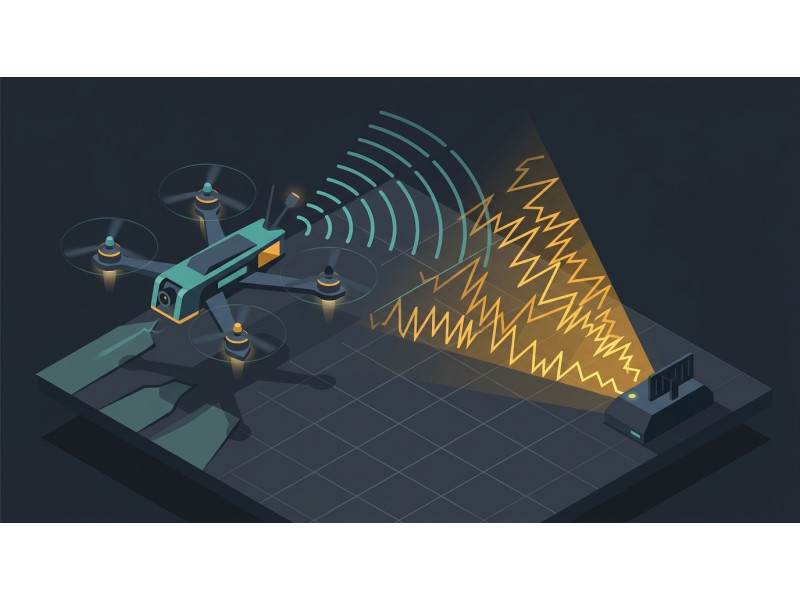
In short: an FPV drone is a fast drone with
first-person video, and a kamikaze is its strike version with a munition. Both
are radio-controlled, which is exactly why the main defense against them is EW.
Let's break it down.
What an FPV drone is
FPV stands for first-person view. The
operator sees the camera picture in real time and flies the drone as if sitting
inside it.
Such aircraft are fast, agile and cheap.
Control and video run by radio — most often in the 700–1050 MHz band, with some
models using 2.4/5.8 GHz.
What a kamikaze drone is
A kamikaze drone is an FPV aircraft fitted
with a munition. It doesn't return: the operator guides it onto the target by
video and hits it directly.
Its strength is accuracy and low cost. Its
weakness is total dependence on the radio channel. No signal — no guidance.
Why EW is needed against them
Since FPV and kamikaze are
radio-controlled, the most effective defense is to break that link. That's what
EW
does: it jams the channel, and the aircraft loses control before impact.
Physically "shooting down" a
cheap, fast drone is hard and costly. Jamming its radio channel is far more
reliable, which is why EW became the primary countermeasure.
How to protect gear and positions
Defense is built to match the threat
format. For gear on the move — vehicle dome EW, holding a field around the
car. For a soldier on a position — portable handheld EW.
The key condition is that the complex
covers the frequencies of the aircraft that actually fly near you. How to
determine that is in the article on EW frequencies.
Detect, then jam
Against fast FPV, time is everything. The
earlier you spot the aircraft, the better the chance to make it with EW. So a drone detector
is useful in the system: it warns, and EW suppresses.
Together this gives a working pair —
detection plus suppression — which we mention in every article on drone
defense.
Where to start
Identify the main threat: FPV kamikaze,
Mavic with drops, or all together. Then choose the bands and EW format. A general overview of the
tools is in the catalog, and a specific configuration we'll
agree via contacts.
Why FPV changed the rules and what it means for defense
Cheap FPV and kamikaze drones made the
aerial threat mass-scale. An air attack once required expensive hardware — now
an inexpensive aircraft assembled from off-the-shelf parts can carry it out.
The consequence is simple: drone defense
stopped being "an option for big sites" and became necessary for
everyone — from gear on a route to a single soldier on a position. That's why
EW turned from narrowly specialized equipment into a mass-market tool.
For a vehicle owner or a small unit this
means it's worth thinking about vehicle or portable EW in advance, not after the first
encounter with a drone. The cheapness of the threat is offset only by a
systematic defense.
Questions & answers
What is an FPV drone in simple terms?
A drone with first-person video: the
operator sees the camera picture and flies the aircraft in real time by radio.
How does a kamikaze drone differ from a regular FPV?
A kamikaze carries a munition and doesn't
return — it's guided onto a target for a direct hit. It's controlled the same
way, by radio.
Why is EW effective against FPV?
Because FPV depends entirely on the radio
channel. EW jams control and video, and the aircraft loses guidance before
impact.
What's better against FPV — EW or a detector?
They're different tasks: a detector finds,
EW suppresses. The most reliable approach is to use them together.