
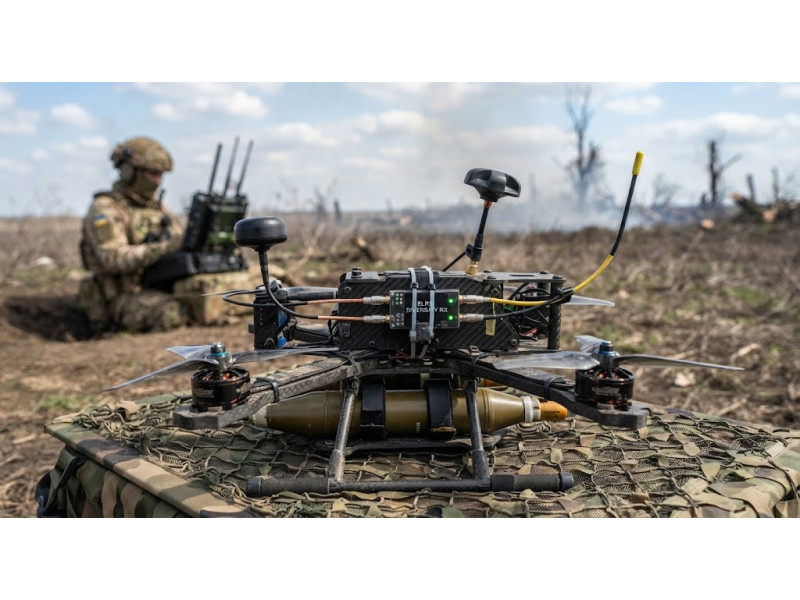
The Role and Application of Diversity Systems in Unmanned Technologies and Communications in the Context of the War in Ukraine
The diversity technology (systems for signal reception and transmission diversity) has firmly established itself in the arsenal of the Ukrainian Defense Forces as a critical element ensuring the resilience of unmanned systems and control stations amidst continuous hostile electronic warfare (EW) countermeasures. In the conditions of an intensive technological war, where every meter of a drone's flight is accompanied by the adversary's attempts to sever communication or disrupt telemetry, traditional single-antenna setups have proven largely ineffective.
System Type and Technical Essence
A diversity system is a receiving or transmitting equipment complex that utilizes two or more independent communication channels (antenas and radio modules) to process the exact same data stream.
The primary element of such a system is an intelligent controller (or a processor integrated into the receiver, such as in the front-line popular ExpressLRS Diversity formats or specialized ground control stations), which automatically and in real time analyzes signal strength (RSSI), incoming packet quality, and interference levels. The system instantly switches the signal path to whichever antenna provides the best communication parameters at that exact microsecond.
How, When, and By Whom It Was Noticed on the Battlefield
Units of Ukraine's strike UAVs and reconnaissance forces began massively adapting spatial and polarization diversity back during the transition phase from simple analog systems to long-range secure communication channels. This technology is visible across all stages of FPV drone deployment, signal repeaters, and ground control stations (GCS).
Diversity receivers have gained particular prominence among crews of heavy strike quadcopters, night bombers (colloquially known as "Baba Yaga"), and operators of long-range FPV kamikaze drones who need to maintain a stable video feed and control link while navigating zones of active hostile radio suppression.
Operational Sectors of Deployment
These systems demonstrate high effectiveness on the hottest sections of the frontline, where the density of enemy electronic warfare complexes is at its peak:
Eastern and Zaporizhzhia sectors (including Kupiansk, Pokrovsk, and Toretsk directions), where the adversary saturates the contact line with dome-type and trench EW stations.
Southern sector, where the specifics of open steppe terrain demand robust communication across maximum operational distances.
Full Description, Functionality, and Application in the War in Ukraine
The functionality of diversity systems relies on combining different types of antennas within a single receiving node (either on the ground station or the platform itself). A classic combination includes:
Omnidirectional Antenna: Provides uniform 360-degree reception, which is critical during close-range drone maneuvering or low-altitude flights entering blind spots.
Directional Antenna (Patch or Helical): Features a high gain coefficient and operates within a narrow sector, enabling the "penetration" of distance over tens of kilometers toward the target.
In the conditions of the war in Ukraine, where the radio frequency spectrum is heavily jammed by both enemy and friendly EW assets, diversity receivers automatically mitigate signal fading, multipath reflections from terrain, and the consequences of active jamming. If one antenna falls into a radiation pattern null zone or gets blocked by an obstacle, the switch routes the stream to an alternative path within fractions of a millisecond.
Comparison of Diversity with Nomad-type Solutions
In the context of modern radio communication modules (such as the RadioMaster Nomad equipment lineup widely used in FPV and UAV spheres), the technology reaches a new level through the adoption of multi-band capabilities.
Architecture and Frequencies: Classical diversity systems operate primarily within a single frequency band (e.g., 915 MHz or 2.4 GHz), simply switching between different antennas (spatial or polarization diversity). In contrast, systems of the Nomad format implement the Gemini Crossband concept, combining parallel operation or rapid switching directly across different frequency bands (2.4 GHz and 900 MHz) using four independent antennas.
EW Resistance: While a narrowband classical diversity system can potentially be suppressed by targeted barrage jamming on a specific frequency, Nomad-format systems can dynamically maneuver between bands, ensuring a significantly higher survivability rate for the control link in complex electronic environments.
Complexity and Integration: A classical diversity receiver is simpler to configure and less expensive, whereas systems with cross-band redundancy require more careful selection of compatible onboard equipment and physical space for mounting multiple antenna elements.
Advantages of Usage
High EW Resilience: Reduced risk of total communication loss during movement of a mobile object or exposure to directional interference.
Increased Range and Stability: The ability to combine the wide coverage of an omnidirectional antenna with the long-range penetration of a directional panel.
Process Automation: The operator does not need to manually switch channels or alter the orientation of the receiver during critical drone maneuvers.
Configuration Flexibility: The ability to combine different polarization types (RHCP/LHCP) and frequency bands depending on the operational environment.
Disadvantages of Usage
Increased Weight and Dimensions: The presence of multiple antennas, extra cables, and a more complex receiving module adds weight to the equipment, which is critical for mobile teams.
Cost and System Complexity: Such setups are more expensive to manufacture and configure compared to traditional single-antenna solutions.
Vulnerability of Cable Routes: An increased number of connectors (SMA/RP-SMA) and high-frequency adapters creates additional points of failure in field conditions due to mechanical damage or moisture.